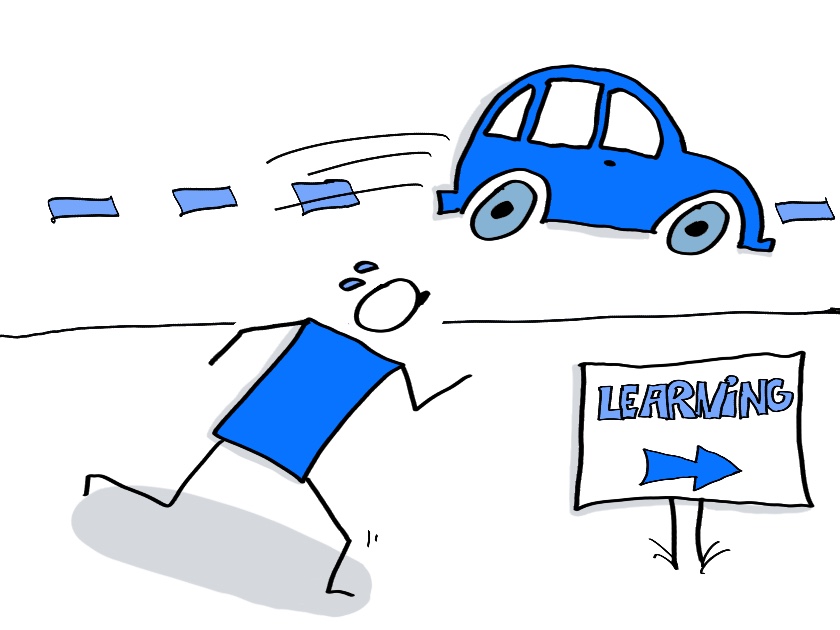

A couple years ago I had an interesting conversation with a good friend of mine about… the meaning of life. Yeah, cliché, I get it. At the end of the day we came to the conclusion that it’s a very personal concept, and I left that conversation ruminating what was my own definition of meaning.
I noticed that everyday I learned something new was a good day for me. Any day I felt I got better at something had a special meaning to me: learning how to play a new song, learning a new chess opening, experimenting with photography, etc. At that point I felt like learning and sharing what I learned with others was something meaningful, and maybe the meaning of my life.
Do you know who agrees with me? Neil deGrasse Tyson a random 6 years old kid. 10 years ago the kid asked Neil about the meaning of life, and if this kid followed the advice he received I bet he’s very smart 16 years old today.
To learn or not to learn, that is the question
Do you know who else likes to learn? The Machine.
Machine Learning is not really a new concept. I remember studying it in college and even taking a course by Andrew Ng around 2013 when I was trying to come up with a way to introduce a classification algorithm in a product my company was creating.
But we never had enough stolen data or computational availability to make something like the LLM’s we have nowadays, so the models we created back then were domain-specific and could never do what the LLM’s do today. We learned a lot while exploring the concepts, and even though the results weren’t astonishing it made us geeks quite happy.
What bothers me with the current scenario is that learning is losing meaning for some people because they see no point in spending their time learning a craft just to be outperformed by an LLM in a couple of seconds.
For example: I like to draw all images I use in this blog. It takes time, yes. But as I learned from my shrink after about 5 years of therapy: You don’t need to be productive at every moment, Mario!
Why would you write code if the LLM can write it 1000x faster?
Well… Why would a 79 years old Drauzio Varela run a marathon? He took almost 5 hours to cover that distance! Had he taken an Uber he would achieve the destination in 30 minutes! He was able to do that because he trained hard since he was 50, and during that journey his muscles, his heart and his brain learned how to endure such a strenuous effort.
My point is: There’s value in the journey, and learning is always a journey.
Creating vs Reacting
During the Regional Scrum Gathering South Africa, Chris Garvey made a fun wordplay with the words CREATING and REACTING, and it really fit the theme of this post. He used the same letters to create two different words, and these words represent two very different ways we can work with LLMs. After all, how much can you learn when you’re just reacting to the tsunami of content generated by LLM’s nowadays? Can you use LLM’s to actually develop a craft and learn as you move forward?
Basically, I see two different approaches when working with an LLM:
1- Can you write a text for me? Fast. Potentially no learning involved.
2- Hey, I wrote that. Can you give me some feedback? Slow. Potentially some learning involved.
I use the second. I write my posts, and that gives me an incredible leverage while using an LLM to provide feedback about what I wrote. For one: If the LLM provides a feedback that doesn’t make sense, I ignore it. Or question it.
Besides that, I have a Claude project with all my blog posts and a values.txt file where I state my personal mission (the same content you can read on my About Page). Whenever I write a new post, I ask it to:
- Hold myself accountable to my values
- Find meaningful connections between the current post and previous posts I wrote
- Find typos and help me to improve my english vocabulary
- Check people I mentioned and suggest diverse people so I can burst my bubble and do my part in making the IT world more heterogenous.
I can’t tell you how much I learned by doing that. I found many people outside the AI echo-chamber that is LinkedIn, and I got a book recommendation that changed the way I feel and relate to LLM’s in general: “The Empire of AI” by Karen Hao. It hits hard, and even though I knew some of the problematics behind the whole AI ecosystem the book shed light to other impacts I was previously oblivious to. In its later chapters it also showed how LLM’s and SLM’s can be created and used in a more conscious way and produce real benefits to the humanity as a whole.
Not because the final posts are better written (I can’t even say if they are), but because the journey of writing started making me learn more. And the same idea can be applied to programming, or drawing or whatever you find pleasure in doing, as long as you keep creating instead of just reacting to what the LLM created for you.
I still think that learning gives meaning to my life, and I try to do that as much as I can. It’s harder now, with all the AI noise around us, and still… not only it’s still possible to learn, but we can consciously choose to do so when we inevitably interact with the LLM’s in our daily lives. Creating is still a choice we can make, and learning is the outcome we might get out of it.
Most people (myself included) are learning how to deal with AI in productive ways. But notice that this is a lesson that comes with a dependency: take the LLM away, and you don’t have a valuable skill. And guess what? LLMs aren’t free. You can use them to learn how to work without them, to burst your bubble.
That’s what I’m trying to do: exploration. Learning for the sake of learning. I’m trying to create more, and react less.