
You know those reflections that suddenly pop up and seem to stick in your head like a catchy song? Well… The other day a question caught me off guard during a training on agility for a class from Portugal.
I had just finished explaining the origin of the Agile Manifesto and elaborated a bit on what happened afterwards when a student hit me with the question:
In your opinion, what are the future directions of agility from now on?
At that moment I tried to retrace the path we’ve traveled so far, and the debate that followed began with an analysis of this path to identify clues that could help me sketch what lies ahead.
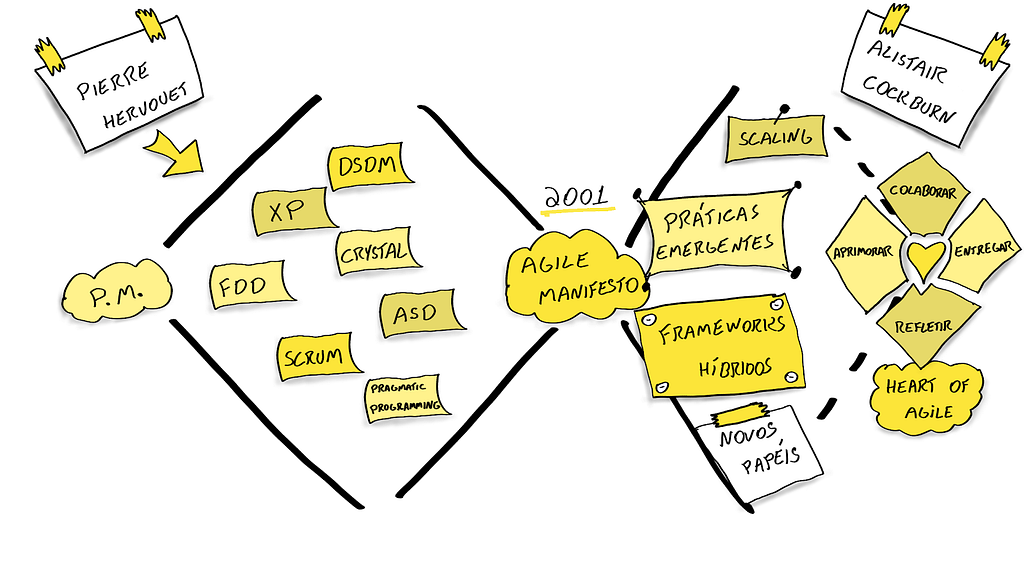
My interpretation of Pierre Hervouet’s illustration about the history of the Agile Manifesto and what came after
If everything started in software development, how did we get to where we are?
I’ve asked myself this question thousands of times. And I’ve seen many people angry because nowadays we have many agilists who have never written a line of code in their lives. Well, I confess I’ve been angry about this too.
But not anymore.
There was a time when it was necessary to convince people that investing time in automated tests was actually a good idea.
And it was hard, very hard.
Continuous integration servers, automated deployments, lean documentation… All these concepts faced strong resistance for quite a while. And that’s where agilists invested most of their time and effort: alongside developers, helping them create mechanisms to reduce the pain caused by changes in software specifications.
But at some point something changed.
Perhaps the market itself got rid of companies that couldn’t adapt to good software development practices, or perhaps the internet and social networks helped raise awareness about the importance of technical excellence and automation of tasks most prone to human failure.
This transition brought to light a new range of challenges. Basically, if Wagner Moura were an agilist this would be the moment when he would migrate from the movie Elite Squad to Elite Squad 2, realizing that the enemy is now different.
And who is this new enemy?
That’s the million-dollar question. In fact, the answer to this question usually is worth much more than that.
The new organizational problems are not as explicit and standardized as those we used to have at the operational level. We no longer have a recipe that can be prescribed to solve these problems and we need to analyze case by case.
That’s why the Scrum Guide that once had 19 pages and recommended specific tools for tracking each cycle has become only 13 pages, of which 5 speak exclusively about the theory and main concepts of the framework.
Self-medication without a diagnosis can generate side effects worse than the symptoms themselves. And this becomes more true with each step that agility takes towards the unknown.
But then can I forget the operational part?
Not every organization has actually managed to leave the first “Elite Squad” behind. But even these can already visualize the next possible problems if they evaluate scenarios already explored by other organizations. Then it’s necessary to work with “one eye on the fish and one eye on the cat”.
At its core, agility tries to improve the organizational system. Everything started at the most operational part, but gradually we discovered that to change the system we would need to also work in areas further from software development.
And as Wagner Moura would say, the system is… difficult.
Ps: Just to clarify: we don’t actually have enemies, and that was just a figure of speech. :)